
ASA rates Illinois’ Medical Cannabis Program

Each year, Americans for Safe Access (ASA) prepares a report that assesses legislative and regulatory improvements in medical cannabis programs across the country, including Illinois. The ASA, the nation’s largest nonprofit that represents medical cannabis patients, doctors, and researchers, listed in its 2021 State of the States report these Top 5 Key Takeaways
Click for ASA report
- Growth is a General Trend
- Small Changes Can Make a Big Difference
- The Cost of Medicine Remains a Major Burden for Patients
- No State is Perfect, There are Always Improvements to be Made
- Programs Can’t Reach Full Potential Without Change in Federal Law
The ASA report stated, “Although conditions have improved for patients significantly in the past two decades, our 2021 State of the State report clearly shows that even after 25 years, states are falling short on providing safe, legal, and affordable access to all patients . . .What this report reflects is that the state-by-state model does not address many medical or logistical needs for patients, it only serves a privileged class of Americans with the resources available to access medical cannabis.”
ILNJ photo
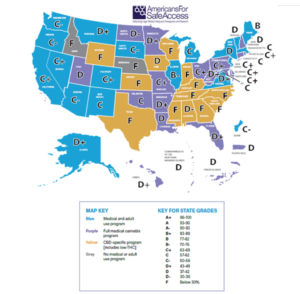
As for Illinois, the Prairie State ranked second out of all states that have legalized medical use of cannabis at 71.86%, which was behind only Maine’s 76.14%. Illinois and Maine were the best-graded states and each scored a B+. However, the “high” grading is deceiving because of the overall lack of medical cannabis patient care and low scores for all the states. The ASA report purposely stated that it “is designed to show that even the states with high scores can and should make improvements, and to highlight the specific advancements that states and territories should pursue to improve medical program function and cost to patients.”

Illinois’ grade was one of the few states in which the grade had been reduced from last year’s report, from A- to B+. The report stated, “This trend demonstrates that even after initial medical programs open there is still a considerable need for lawmaker and regulator engagement with patients and stakeholders to identify challenges and make improvements that result in better outcomes for patients.” For the rubric created to score these grades, click here.
ASA gaphic
Last year, Illinois had 136,530 registered medical patient, which was 1.08% of the state’s population. Illinois registered around 36,000 new patients in 2021. For the past two years, Illinois has been stuck on 55 retail locations currently open with no future plans to add more. That is one store per 2,482 patients. Surveyed feedback from patient included
- Patients were split on their favorability of the medical cannabis program in the past year, but a narrow majority gave it favorable reviews.
- The majority felt that access had improved thanks to the requirement to register at every dispensary they shop at being dropped, a change they were enthusiastic about.
- Those who saw no noticeable change in the program or felt that access got worse cited the rising prices and the scarcity of effective products like RSOs, and edibles due to adult use customers buying them up.
- Most patients in Illinois feel that there are not a sufficient number of dispensaries to meet patient demand.
- Patients in Illinois reported some of the most prohibitive costs in the entire report, most respondents said they paid over $60 per 1/8th of flower.

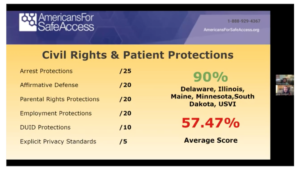
The report classified grading into six different categories: Patient Rights & Civil Protections (45/100), Affordability (65/100), Program Functionality (90/100), Health And Social Equity (75/100), Consumer Protection (138/200), Product Safety, and Penalties Scores (0/100).
Improvements and recommendations for the Illinois’ Compassionate Use of Medical Cannabis Program included
- Adding delivery or curbside pickup options for patients as a measure to improve access
- Extending reciprocity measures so that visiting patients have access to medical cannabis products
- Parental rights and protections
- Better affordability

“ASA’s evaluations of state grades are based on an analysis of the individual laws and policies which govern each state’s medical cannabis program,” the report stated. “We look at state programs both in isolation as well as in comparison to other state models to determine scoring standards that can be reasonably applied across the board. This report is designed to show that even the states with high scores can and should make improvements, and to highlight the specific advancements that states and territories should pursue to improve medical program function and cost to patients.”
For more news about the Illinois cannabis industry, click here.
