
Cannabis smell no longer probably cause for vehicle search

Monday, a court ruling by the Appellate Court of Illinois (Third District) delivered the judgment that the “smell of burnt cannabis” alone did not provide an “officer with probable cause to search the vehicle.” According to Associate Judge Daniel P. Dalton of the Whiteside County Court, the decision hinged “on the changing landscape of cannabis law.”

According to the case, “The State and the defendant stipulated to a short recitation of facts: (1) on May 9, 2020, the officer executed a traffic stop after the defendant disobeyed traffic laws; (2) the officer approached the defendant’s vehicle and smelled a strong odor of burnt cannabis emitting from inside the vehicle; (3) the defendant told the officer that someone had smoked inside the vehicle ‘a long time ago’; and (4) based on these observations and admissions, the officer searched the vehicle.”

The State argued that the 1985 Supreme Court case of People v. Stout, which found that the odor of burnt cannabis alone was enough to search the vehicle, was still controlling caselaw. The State argued that since it is illegal to smoke cannabis within a vehicle on a highway, the smell of burnt cannabis provides probable cause to search the vehicle.
The defense argued “that, since the legalization of cannabis, it should be treated the same as alcohol, which requires more than just the odor of an alcoholic beverage for probable cause to search a vehicle. The defense noted that the odor of burnt cannabis can linger and ‘sit on somebody,’ and there was no smoke or other evidence to suggest that cannabis would be in the vehicle. Moreover, the officer did not deploy a canine, discuss the defendant’s impairment, or do any field sobriety testing.”

After setting forth the changing landscape of cannabis law and its relation to probable cause to search a vehicle, the Court then considered whether the officer, on the facts before them, had probable cause to search the defendant’s vehicle. The Court ruled that the “smell of burnt cannabis, alone, coupled with the defendant’s statement that someone (he did not state that it was himself) had smoked in the vehicle ‘a long time ago,’ was not enough for a reasonable officer [to] conclude—considering all of the surrounding circumstances, including the plausibility of the [innocent] explanation itself—that there was a ‘substantial chance of criminal activity.’”

The decision continued by stating, “It was legal for the defendant to possess some cannabis. It was also legal for the defendant to have smoked cannabis and then drive, so long as the concentration in his blood or urine did not pass the threshold amount. The evidence presented does not show that the officer had any concerns with the defendant’s blood concentration or any impaired driving. We note that the stipulation does not state which traffic violation the defendant committed. A traffic violation, in and of itself, is not necessarily indicative of impairment. There was no reason for the officer to think that the defendant was currently smoking cannabis in the car—there was no indication that there was smoke in the car, nor did the officer see any marijuana or drug paraphernalia, nor did the defendant’s demeanor show that he was hiding anything. Moreover, the smell of burnt cannabis may have lingered in the defendant’s car or on his clothing. Simply put, there was no evidence that would lead a reasonable officer to conclude that there was a substantial chance of criminal activity afoot.”

The decision added, “We hold that the smell of the burnt cannabis, without any corroborating factors, is not enough to establish probable cause to search the vehicle, and the court did not err in granting the motion to suppress. This finding comports with the Supreme Court’s holding in Hill and its treatment of the analogous situation regarding alcohol. Thus, the supreme court’s holding in Stout is no longer applicable to postlegalization fact patterns.”

The Court also reiterated the Illinois law that already exists, namely that “Cannabis may not be possessed in a vehicle unless it is in a ‘reasonably secured, sealed container and reasonably inaccessible while the vehicle is moving’” and that “a person may not use cannabis while in a vehicle or drive a vehicle if the person has, within two hours of driving or being in actual physical control of a vehicle, a THC concentration in their blood or urine of either 5 nanograms or more of delta-9-THC per milliliter of whole blood or 10 nanograms or more of delta-9-THC per milliliter of other bodily substance.”
On the same day of the court decision, Senator Don Harmon sponsored an amendment to the Illinois Vehicle Code and Cannabis Regulation and Tax Act, which added the following wording to the law: “The odor of burnt or raw cannabis in a motor vehicle by itself shall not constitute probable cause for the search of a motor vehicle.” For more Illinois cannabis industry news, click here.
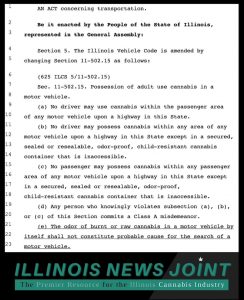
Cannabis Regulation and Tax Act amendment
To learn about cannabis-friendly events in Illinois, click here.
For Illinois News Joint reviews, click here.