
News Joint concludes first Scientific Grow Journal
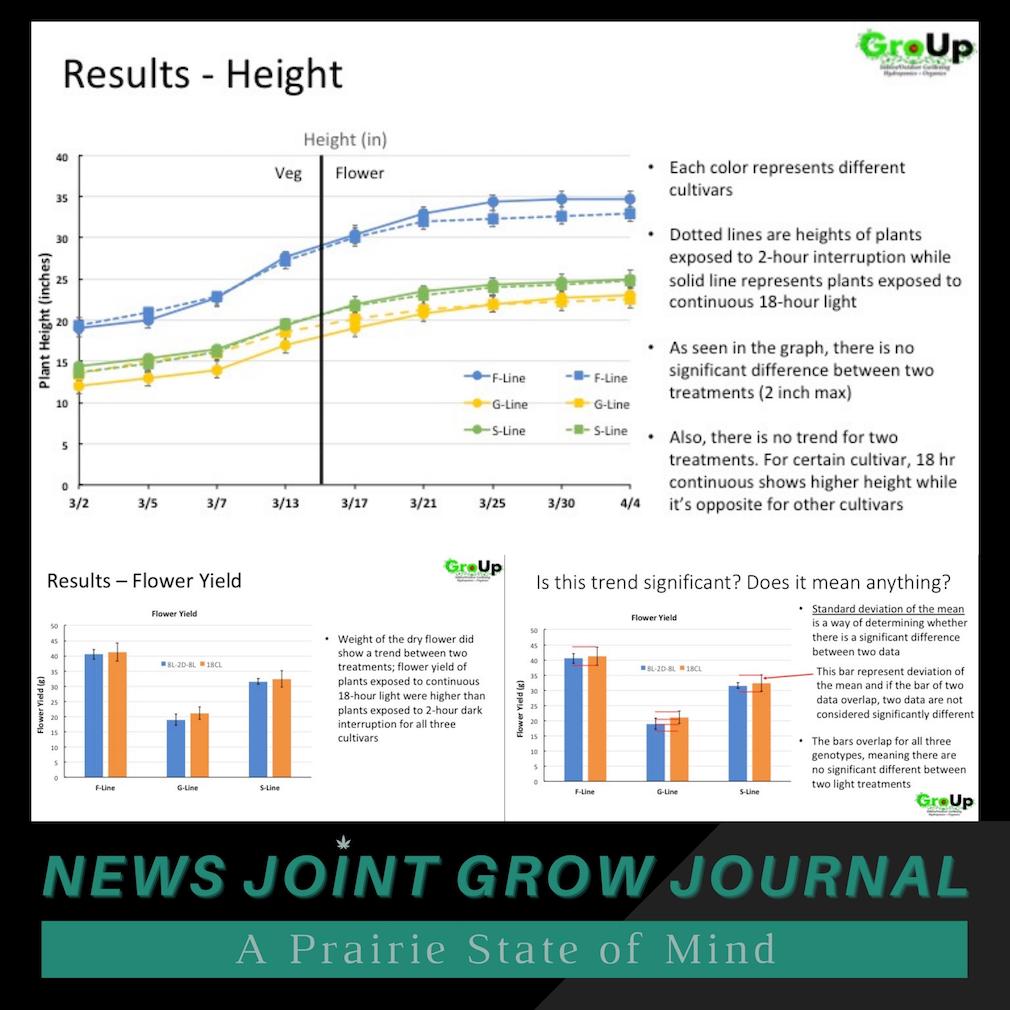
As mentioned in the first two Scientific Grow Journal entries, the purpose of this experiment conducted by Dr. Dokyoung (D.K.) Lee was to better understand if turning off light for a certain period during the afternoon, when energy cost and chances of power outages are greater, would affect the yield of the cannabis plants.
With help from his graduate students, Dr. Dokyoung (D.K.) Lee, who is the crop sciences professor and director of online masters programs at the University of Illinois Urbana-Champaign, created this inaugural Scientific Grow Journal with two Lighthouse 2.0 4’x4’ tents installed with NextLight 420h LED Grow Light (sponsored by GroUp Gardening).

Other setups included 9 plants per tent and 3 plants per the 3 genotypes with a targeted temperature of 75-80F and targeted light intensity at 600 umol per square meter per second. The grow medium included Berger BM7 soil / Classic 600 (2-gallon) pot.

The conditions for each grow tent were the same, except in one tent the light was turned on for 18 hours continuously (6-12 a.m.) and in the other tent the light was turned off two hours from 2-4 p.m. Lee is growing strains from his F-Line, G-Line, and S-Line that he propagated at the University of Illinois.

The plants were placed into the ten February 15 and harvested April 26. The heights of each plant were recorded three times per week. Other noticeable observations were also recorded. The plants were harvested April 29 and weighed.

In the first chart, Lee and his team measured the height of each treatment of plants. According to Dr. Lee, there was “no significant difference between two treatments.” In addition, there was no trend for the two treatments.

ILNJ chart
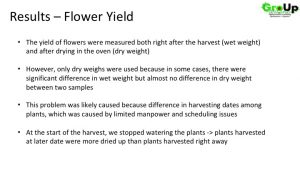
In the following bullet-point graphic, Lee and his team measured the yield of the flower right after harvest for a wet weight and after drying for a dry weight, but used only the dry weight.
ILNJ graphic
In the following bar chart, Lee notes that the weight of the dry flower did show a trend between the two treatments. The flower yields of plants exposed to continuous 18-hour light were slightly higher than plants exposed to 2-hour dark interruption for all three cultivars.

ILNJ chart
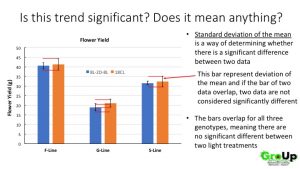
In the next bar chart, Lee discusses standard deviation of mean as a way of determining whether there was a significant difference the sets of data.
ILNJ chart
For the final bullet-point graphic for this experiment, Lee concludes for this Scientific Grow Journal that there was no difference in height or weight measurements, and therefore, no significant effect on the 2-hour dark interruption growth and flower yield.

ILNJ chart
Check back soon for more Scientific Grow Journal entries as we are working to schedule new studies for the spring semester, possible fall. Visit our YouTube page for Scientific Grow Journal videos. Follow all of our Grow Journals here.
For more Illinois cannabis industry news, click here.
To learn about cannabis-friendly events in Illinois, click here.
For Illinois News Joint reviews, click here.